A public meeting nobody can follow isn't public.
Council sessions, planning hearings, and community consultations, translated live to every resident's own phone — in the room or at home — with a translated transcript afterwards for the record.
No receivers to buy, procure, or sanitize · Pricing per language-hour
The meetings residents are entitled to understand.
Regular sessions and votes
Recurring meetings are the hardest thing to staff interpreters for, because they happen constantly and nobody knows in advance which languages will walk in. Open the languages your community actually speaks and leave them running.
- No booking an interpreter for a meeting that might be quiet
- Same-language captions also serve residents who are hard of hearing
Planning, housing, and licensing
The meetings where turnout matters most are usually the ones affecting neighbourhoods with the most languages. Translation removes the reason people stay home, and the transcript shows who was told what.
Information evenings and briefings
Emergency preparedness, school placement, benefits, waste collection, integration programmes — sessions where being understood is the entire point of the event.
Where a human interpreter is still required
Koine is for the public-information side of civic life. Proceedings with a legal requirement for a certified interpreter — court hearings, sworn testimony, formal legal advice — should keep using one. We'd rather tell you that up front than sell you into the wrong room.
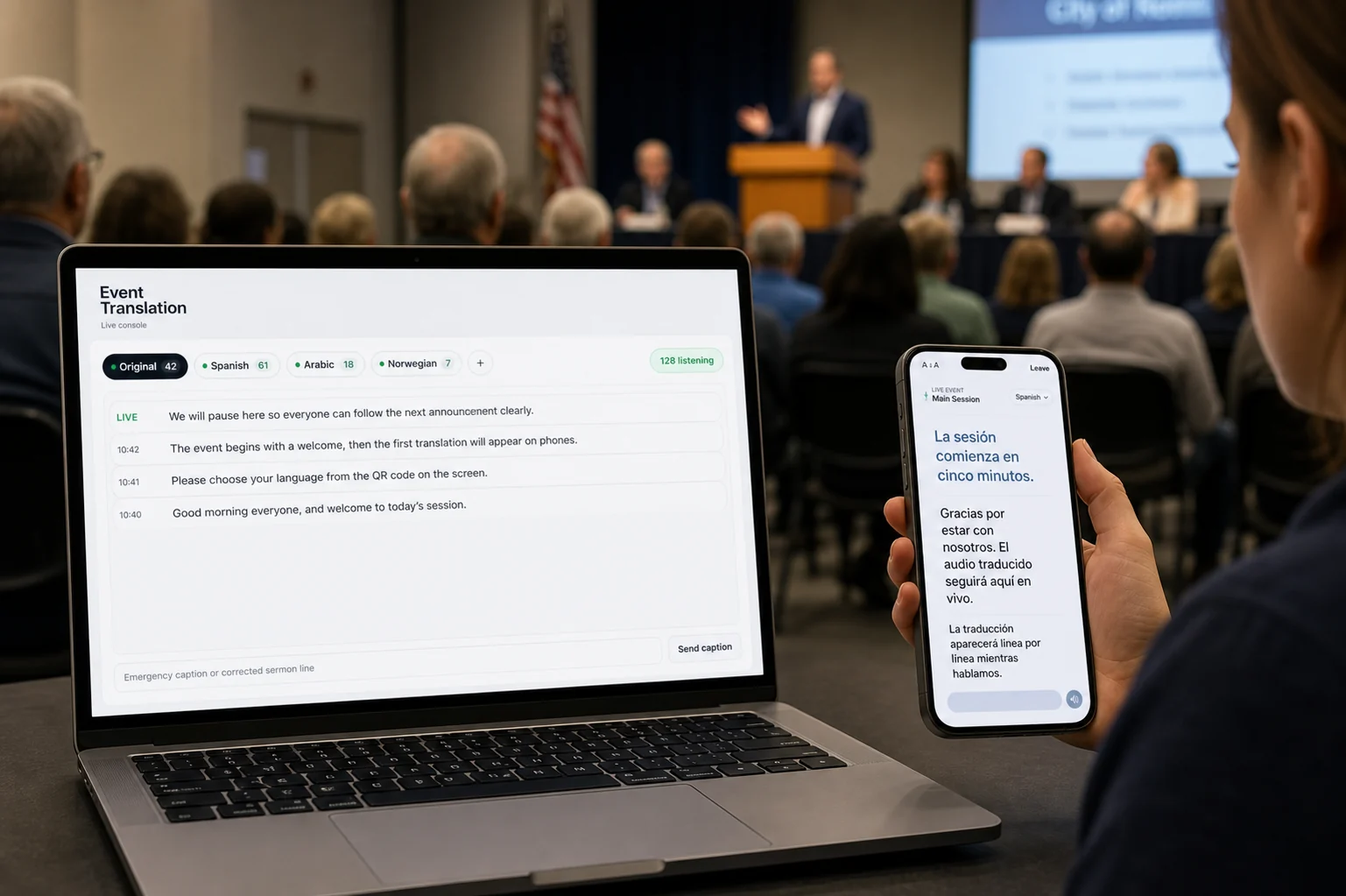
Nothing to hand out at the door.
Receiver hardware means an inventory to buy, a person to distribute and collect it, batteries to charge, units to clean, and a fixed number of languages decided months in advance. A join code on the screen replaces all of it.
- No capital purchase and no asset to track between meetings
- Languages chosen the same week, not at budget time
- Residents at home included on the same session — see remote listening
- Captions on the room screen for everyone at once — see overlays
Evidence, not just intent.
Public bodies are usually asked to show that information was made accessible, not merely that they meant to. Every session leaves a translated transcript per language, so what was communicated — and in which languages — is documented rather than remembered.
A transcript per language
Not just the original minutes — the actual text residents received, in the language they received it in.
You choose what's public
Sessions are private until you publish them. Closed or internal meetings never appear on a public page.
A permanent public address
One page listing what's live, what's scheduled, and the published archive — see your page & followers.
Koine is a tool for providing language access, not a legal opinion on your obligations. Which meetings require certified human interpretation is a decision for your own legal and accessibility teams, and we're happy to talk through where the line sits for your organization.
Inside your existing chamber.
Take the floor feed
Connect to the chamber's existing microphone system — the same feed the record is made from.
Open the languages
Pick the languages your community speaks and put the join code on the screen and the agenda.
Keep the record
Sessions save a translated transcript per language, and you publish the ones that belong in public.
Per language-hour, not per resident.
A two-hour council meeting in three languages is six language-hours. Attendance never changes the price, so making a meeting more accessible never costs more for being more popular.
Recurring meetings
Monthly
For bodies that meet on a schedule — included language-hours, overlays, and recordings.
Compare plans →Public sector
Custom
Procurement, invoicing, data questions, an SLA, and support for larger chambers or several sites.
Contact us →Public-sector questions.
Is machine translation good enough for a public meeting?
For understanding what is being said and decided, it is generally far better than the realistic alternative, which is usually nothing at all. For proceedings where a certified interpreter is legally required, it isn't a substitute — see the note above.
Where is the audio processed and stored?
Sessions run through our hosted platform, and recordings are stored privately for your organization. If you have specific data-residency or retention requirements, raise them with us before a pilot — get in touch.
Can we run it without publishing anything?
Yes. Publishing is per session and off until you choose it. You can use Koine purely for live access in the chamber.
Do you support procurement processes?
Yes — invoicing, documentation, and pilot scoping for public bodies. Contact us and tell us what your process needs.
Which languages are available?
Over 50 for translated voice, and considerably more for captions — including right-to-left languages. See live translation.